Submitted by jeffpsmith on Tue, 04/01/2025 - 10:40
Submitted by jeffpsmith on Mon, 03/31/2025 - 11:12
In Evanston, Illinois, running “against Trump” is an easy shot. Minimal risk for a candidate. Evanston voted overwhelmingly Democratic, and likely even most “Trump voters” aren’t even fans but voting on party basis. So if you can get most of the Harris voters, you win, right? Heck, on a nearby block the other day I counted more Harris-Walz signs up than for all municipal candidates combined. However, this easy shot in a deep blue town is also a cheap shot, because to campaign as if Trump is the opponent suggests that an opponent is in the Trump camp. In the April 1, 2025 election -- tomorrow, as I write this -- that’s just not true. Here's why.
Submitted by CSNA on Mon, 03/03/2025 - 08:54
Each candidate for mayor of Evanston returned a short questionnaire CSNA sent them in advance of tomorrow's forum (Tue., Mar. 4, 2025, 7-8:30 pm at 2715 Hurd). Click to view or download their responses.
 Daniel Biss
Jeff Boarini
Submitted by CSNA on Wed, 02/26/2025 - 08:45
In a little less than five weeks, Evanston will hold municipal elections. The post of Mayor and most City Council seats, including north Evanston's 6th and 7th Ward Councilmembers, are heavily contested.
Over the past 18 years, CSNA has earned a reputation for some of the most provocative and well-attended candidate forums in Evanston, no softball questions, focusing on substance. In upcoming days we'll offer two chances to let our members and the public see and hear real differences between the 2025 candidates:
Submitted by CSNA on Tue, 02/25/2025 - 20:43
All four candidates for Councilmember in Evanston's two northernmost wards returned a short questionnaire CSNA sent in advance of tomorrow's forum (7-8:30 pm at Northminster Church). Click to view or download their responses.
Submitted by jeffpsmith on Sun, 02/23/2025 - 23:55
“In 2023, about 77,800 residents lived in Evanston, which is nearly 5% more than the population in 2000 … [and a] growth rate of 0.35% annually [from 2010 to 2023], with a projected population of about 84,175 by 2045.”
City of Evanston, “Envision Evanston 2045” (Nov. 2024 draft), at 16
“Evanston’s total population decreased slightly between 2000 and 2020 (-2%) and the number of households decreased by 5%.”
City of Evanston, “Draft FY 2025-2029 Consolidated Plan and 2025 Action Plan” (Nov. 2024) at 81
Is Evanston growing so fast that it needs to build a lot more buildings to accommodate a projected additional 7,600 residents in the next 20 years,1 growth of more than 10%? This was a core tenet of the Envision Evanston 2045 process and the upzoning agenda that's been driving it for over a year, even before its launch. But for several reasons, this assumption was always so broken that just by itself it warranted a reset of the entire planning process. The good news?
Submitted by jeffpsmith on Sat, 01/11/2025 - 23:57
 While focus in ongoing "Envision Evanston 2045" debate has been on the proposed upzoning of current lower-height residential districts (R1, R2, and R3), eliminating all single-family, 2-flat, or 3-flat zoning to allow 3-story, 4-unit buildings as of right everywhere, all business districts are also quietly targeted for dramatic upzoning to turn our streets into "corridors." What would this look like?
Submitted by jeffpsmith on Fri, 01/10/2025 - 16:38
Documents coming to light through FOIA plus comments by staff show that the “Envision Evanston 2045” planning process has been steered since the bidding phase towards a “Minneapolis model” of rezoning. Proponents claim that Minneapolis has shown that upzoning and increased population density will lower housing costs. Is that true? Research suggests “not really.”
What Did Minneapolis Do?
Minneapolis lowered parking requirements and then, in 2019, eliminated single-family zoning districts, along with other upzoning, ostensibly to increase affordability through more supply. Tens of thousands of units were built, mostly through larger developments. Minneapolis’s upzoning has been called “far and away the largest densification project ever attempted in all of North America.”1 So its recurrence in City of Evanston communications, going back to before any public meeting, is no accident, but amounts to an explicit call for upzoning and density. This is significant, evidencing that a predetermined desired zoning change has shaped the Plan, rather than the normal. logical, and fair sequence of letting community-driven planning first occur.
The purpose of this writing, however, is not to dwell, for the moment, on the procedural implications of that, concerning as they are. The purpose here is to take a deeper dive into the assertion that Minneapolis's experiment "worked" and provides a template that Evanston can readily adopt with similar results. Is that so?
Submitted by Mary Rosinski on Thu, 01/09/2025 - 00:00
I believe that Evanston residents support affordable housing. I know I do. However, rezoning an entire city, and lifting regulations on height, bulk, and parking, conflicts with other goals, not least of which are our environmental goals. It also negatively impacts the homes and rights of residents who have invested in their homes and neighborhoods. So the affordability benefits need to be substantial to justify that. Would upzoning all our R1, R2, and R3 districts -- most of the residential land area of Evanston -- as well as all the business strips and downtown areas where thousands of renters and condo owners live, really do that?
Submitted by jeffpsmith on Fri, 12/20/2024 - 12:15
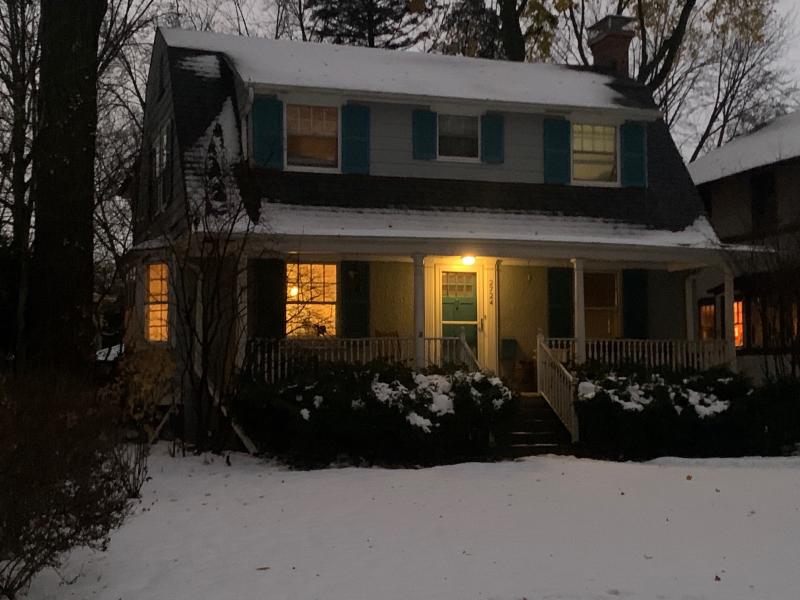
Two things stand out in the current zeal of some in Evanston, Illinois to villainize if not obsolete the single-family neighborhood. One is the misplaced blame. In Evanston, single-family homes are an atypical (for the suburbs) minority, albeit a key part of the community. So these dwellings don't drive the market, they reflect it. The other is the complete disregard for the popularity of single-family houses. Overlooking that shows disrespect for quaint notions like choice, freedom, empowerment, and personal space. Right: The author's 2200-sf Dutch Colonial of 34 years, built 1922-23.
Pages